Labconscious®

Connecting biologists to green labs and sustainability
  • Home
  • Blog
  • Green Lab Tips
  • Lab sustainability training game
  • Resources
    • Laboratory Recycling
    • Guidance on best practices
    • Green Chemistry
    • Supportive Data, Guides and Tools to Optimize Laboratory Energy Consumption
    • Grants and Funding
    • Laboratory equipment and supplies reuse
    • Play & Learn How to Minimize Laboratory Waste
  • Search our site
  • Green Lab Groups
  • Green Lab Supplies and Laboratory Equipment Guide
  • Home
  • Blog
  • Green Lab Tips
  • Lab sustainability training game
    • Laboratory Recycling
    • Guidance on best practices
    • Green Chemistry
    • Supportive Data, Guides and Tools to Optimize Laboratory Energy Consumption
    • Grants and Funding
    • Laboratory equipment and supplies reuse
    • Play & Learn How to Minimize Laboratory Waste
  • Search our site
  • Green Lab Groups
  • Green Lab Supplies and Laboratory Equipment Guide

Green Lab Tips

Our green lab tip articles can help biologists to reduce laboratory waste, use green chemistry, conserve water and save energy.

  • All
  • 3D printing
  • Biotechnology
  • Cell Culture Tips
  • Cold Storage
  • Communications
  • Energy Conservation Tips
  • Energy Saving
  • Glassware
  • Green Biotech
  • Green Chemistry
  • Green Lab Tips
  • Greening lab materials
  • Histology
  • Lab Equipment Tips
  • Lab plastics
  • Microbiology Tips
  • Model Organisms
  • Molecular Biology Tips
  • Protect Biodiversity
  • Recycling
  • Reduce Hazardous Waste
  • Repair strategies
  • Reuse strategies
  • Science and Technology
  • Supply Chain Tips
  • Sustainable Science
  • Teamwork
  • Water Conservation
  • Water Conservation Tips
  • Western Blot
  • Worm Lab Tips

De-Fossilizing Lab Plastics

Nicole Kelesoglu February 13, 2024

In life science, it’s often plastic-polluted ecosystems that firm our resolve to limit the environmental impacts of our lab work. That has set us up for a bit of an existential crisis relationship with single-use lab plastics - the materials that both facilitate scientific progress and accelerate environmental decline. Naturally, we focus on preventing plastic pollution by looking for ways to recycle. The downside is that our distress can distract us from the impact of what occurs upstream when these materials are made. It’s high time to broaden our horizons. Let’s take a moment to recognize a new category of lab plastics as a welcome step forward in sustainability.


Can renewable raw materials help life science go green?

The overall consensus in sustainability research literature has been that the type of plastic is more important than the mass of a plastic part - but does that mean renewable plastics can help life science go green?

It’s been a tall order to answer that question. Using renewables has always been attractive in theory but riddled with complexity. For example, biodegradable plastics sound great, but the characteristics of first-generation resins do not match the capabilities of fossil fuel-based resins for labware. Manufacturers face limited resources for renewable raw materials and those providers need vetting. Lab suppliers also have to compete with other manufacturing sectors for these raw materials. If you want to consider how difficult that is, you might enjoy reading this open-access article: The Plastic Intensity of Industries in the USA: The Devil Wears Plastic. Environ Model Assess 28, 15–28 (2023). (Or perhaps not, if microplastics alarm you!) The demand for feedstocks for biofuel is also stiff competition. Importantly, funding has also been needed to support the science of sustainability. This limits the expertise available to generate data and guidance on various approaches.

Biologists can use a recent sustainability study to explore the question of what factors matter most for plastics in their lab work. The researchers parsed out the factors involved in the making, using, and disposal of lab consumables that lead to higher carbon footprints using proxy emission factors from products made from the same polymers.(1) Cheers to these authors from the Institute for Sustainable Resources, University College London, and the College of Medical, Veterinary and Life Sciences, University of Glasgow, for uncovering key insights with life cycle analyses! The work points to the value of responsible plastic manufacturing. Alternate lab plastics with lower carbon footprints were encouraged with the caution that the environmental benefits of biopolymers strongly vary depending on disposal and other factors. This paper is an excellent resource to help labs discern their most sustainable options.
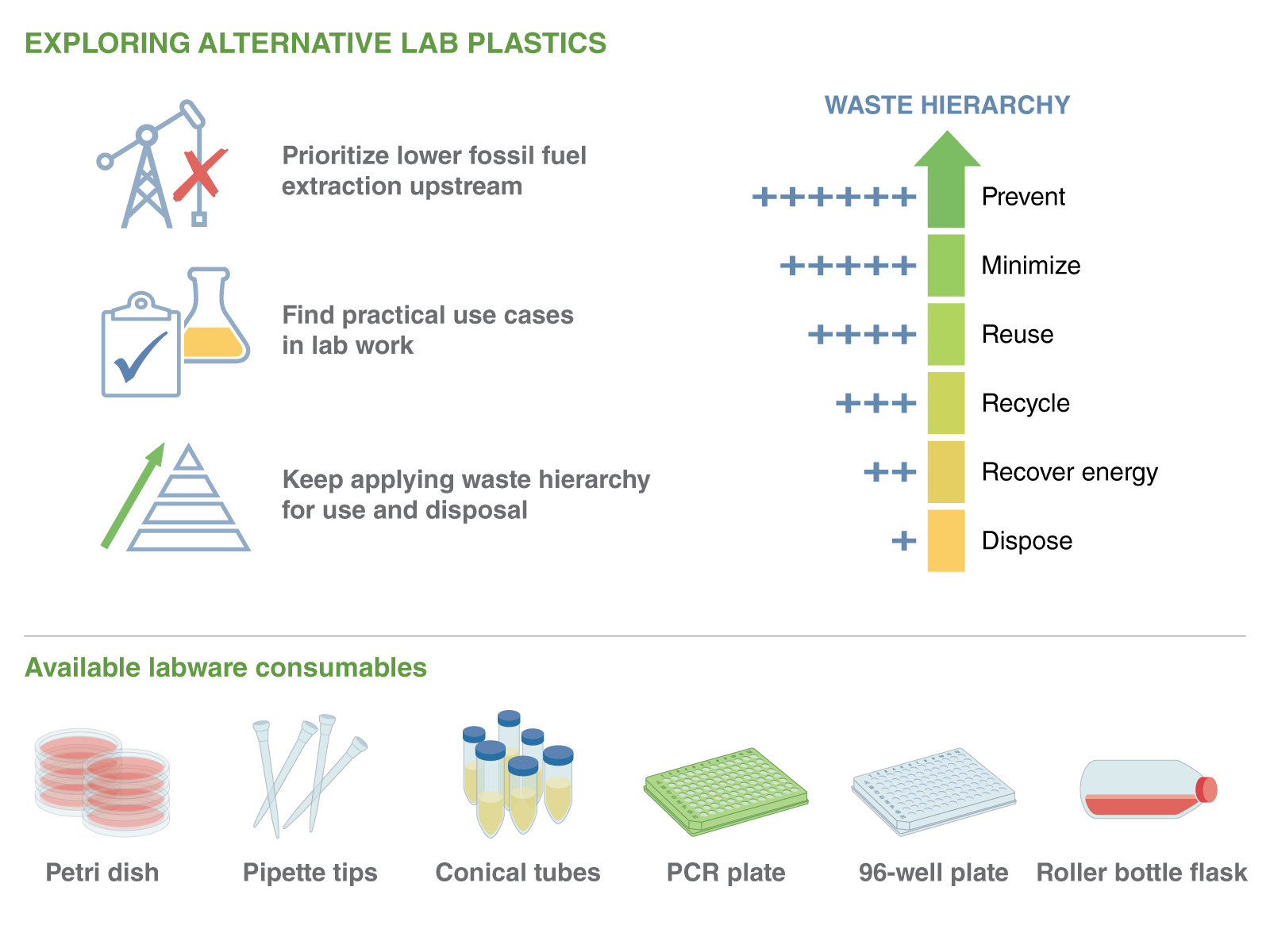
Defossilizing Lab Plastics Infographic_png

A few motivated manufacturers have replaced or reduced fossil fuel-based raw materials that go into making labware:

  • Planet-Safe® Labware from Diversified Biotech, Inc.

  • BioBased and twin.tec® from Eppendorf

  • CellScrew® and labware from Green Elephant Biotech

Each lab consumable has specific use cases recommended by the maker. The waste hierarchy can be used to consider your options for disposal. I encourage scientists to consider if these materials could be used in their lab work. Solving this sustainability issue will require stepwise innovations to meet the needs of life science.

Thanks for being labconscious!


Reference:

  1. Ragazzi I, Farley M, Jeffery K, Butnar I (2023) Using life cycle assessments to guide reduction in the carbon footprint of single-use lab consumables. PLOS Sustain Transform 2(9): e0000080

 
 
Related posts...
The First PLA Plastic Plates Offered for Tissue Culture
February 13, 2024
The First PLA Plastic Plates Offered for Tissue Culture
February 13, 2024

It’s always exciting when a maverick hits the mark. The first polylactic acid (PLA) Petri dish product is a one-to-one replacement for labs using fossil fuel-based plastic plates for cell culture. The maker, a small privately owned company called Diversified Biotech, Inc., collaborated with researchers from Brandeis University to develop it. Fostering eco-justice with a simple swap sounds good, but could this specialized PLA material even improve cell culture?

Read more →
February 13, 2024
Strategies for lab plastic shortages
March 18, 2021
Strategies for lab plastic shortages
March 18, 2021

Ironically, after many years of concern about how to reduce single-use lab plastic usage and divert this waste from landfills - we now face shortages. This post explores current events and ways that life science labs are dealing with pipette tips, plates, and tube shortages, as well as a few high-tech options to conserve these resources and improve the reliability of assay results.

Read more →
March 18, 2021
Could Ozone be used to overcome single use plastic waste in cell culture?
November 7, 2019
Could Ozone be used to overcome single use plastic waste in cell culture?
November 7, 2019

Cell culture vessels are one of the most challenging areas of single-use plastics to consider eliminating from biology labs. Never known for complacency, scientists are seeking are already seeking higher performance to optimize cell culture conditions. From a “labconsicous” perspective, ideally, both cell culture growth conditions and sustainability could be improved. This post considers a controversial idea. Could a system for reusable mammalian cell culture plastic flasks ever be developed?

Read more →
November 7, 2019
Tackling Waste: 5 Steps to Less Plastic Waste in the Lab
September 9, 2019
Tackling Waste: 5 Steps to Less Plastic Waste in the Lab
September 9, 2019

Life sciences laboratories are another area in which plastic waste can be reduced. Approximately 5.5 million tons of plastic waste are produced every year in life sciences laboratories alone, including items like pipette tips, nitrile gloves and cell culture flasks. In the age of global waste pollution and the ubiquity of plastic in the world around us, this is definitely too much. It can’t all be changed, but improvements are possible in some areas.

Read more →
September 9, 2019
Biotech scaling up Nodax™ a Landfill and Waterway biodegradable, biobased plastic
January 30, 2019
Biotech scaling up Nodax™ a Landfill and Waterway biodegradable, biobased plastic
January 30, 2019

Today’s blog is about (truly) bio-degradable Nodax™ PHA plastic, produced by the biotech company Danimer Scientific. Nodax™ PHA was invented some time ago, but its commercialization has just been ignited by food industry investments. Expect this bioplastic to spread like wildfire.

Read more →
January 30, 2019
The Ultimate Lab Swap: Donate Used lab Equipment or Unopened Lab Consumables to Seeding Labs
April 27, 2017
The Ultimate Lab Swap: Donate Used lab Equipment or Unopened Lab Consumables to Seeding Labs
April 27, 2017

Got used lab equipment? Support your scientific colleagues around the world by using Seeding Lab's easy donation process! 

Read more →
April 27, 2017
The Microbead Ban and Responsible use of Microspheres in the Lab
March 27, 2017
The Microbead Ban and Responsible use of Microspheres in the Lab
March 27, 2017

How should the US Microbead-Free Waters act  affect our thinking about the proper disposal of microspheres as lab waste? Learn how biotechnology companies are using the bioplastic PHA with good results and further developing its use for other lab applications.

Read more →
March 27, 2017
Molecule of biodegradable plastic
November 9, 2016
Pipet Tips, Flasks and Plates: Eco-friendly Plastic in Your Green Lab
November 9, 2016

So you want to use 'green' plastic labware, but news headlines about a UN environmental report has you perplexed… 'Biodegradable' Plastics Are A Big Fat Lie. Well, don't worry! Plastic labware can still be a good sustainability option

Read more →
November 9, 2016
InLab plastics Tagslab plastics made with renewable raw materials, lab plastics made with renewables
  • Green Lab Tips
  • Older
  • Newer

Get insights on specific green Lab goals

No results found

Join us!

Get monthly articles and green lab tips to your inbox.

Thank you for signing up for monthly articles and green lab tips!


Interact with the Labconscious community


Email us!

How do you make your biology lab more sustainable?


linkedin-unauthyoutube-unauthx-formerly-twitter-unauthbluesky-unauth
  • Terms of Use
  • Privacy Policy
  • About
  • Contact
  • Cookie Policy
 
New England Biolabs
 

240 County Road
Ipswich, MA 01938-2723

Labconscious® is a registered trademark of New England Biolabs, Inc.

© Copyright 2026 New England Biolabs. All Rights Reserved.

Labconscious®

Connecting biologists to green labs and sustainability

Labconscious is an open resource for biologists to support sustainability and green laboratory work to reduce the environmental footprint of bench science.

New England Biolabs | 240 County Road, Ipswich, United States

linkedin-unauthyoutube-unauthx-formerly-twitter-unauthbluesky-unauth