
From pipette tips to packaging film, laboratory waste is often an accepted byproduct of doing good science. But what if some of that waste isn’t inevitable? For many biologists, the challenge isn’t a lack of motivation—it’s knowing where to start. In this interview, New England Biolabs’ sustainability manager, Levi Rogers, shares how taking a closer look at everyday lab workflows can uncover practical, site-specific opportunities to reduce waste—without compromising safety, rigor or productivity. You may find that solutions already exist for your own bench work.
A Q&A on Evaluating lab Sustainability solutions at NEw England Biolabs - Failures don’t end the conversation

Q1: Why is waste minimization a core pillar of sustainability in Life Science?
Life science workflows and processes are heavily reliant on plastics and other single-use materials, and we know these materials are negatively impacting our environment and human health. Microplastics are everywhere.
It's important for us as a company to monitor our waste streams to help us learn how to better manage and reduce our contribution to the global waste system. That’s why we strategize new programs and processes to reduce waste where we can. While we will likely need to rely on these plastic materials for quite some time, we need to work now to reduce our use and manage them more appropriately, all while seeking alternatives where feasible. We want to do our part to help build an industry where we can really trust that products are truly being recycled, or better yet, circularized.
Q2: What are significant waste streams that biologists commonly participate in?
Rigid and flexible plastics. EPS foam in the cold shipping chain. Regulated waste, like hazardous, non-hazardous, regulated medical waste, and others. Universal waste, such as lab equipment, which needs to be properly decontaminated before getting recycled. Wastewater management is also important for NEB, where we operate our on-site Solar Aquatics wastewater treatment plan. And of course, we see routine waste that you’ll find in most operations, like municipal solid waste and organics, which we manage also manage in specialized waste streams.
Q3: What are some of the big challenges with recycling in laboratories?
Broadly speaking, the waste industry is just not very transparent, and that’s a problem. The waste system is complex, and it’s very difficult to know where material ultimately ends up. We want to know where our material goes after being picked up from our facilities, and we want to learn how our material is managed when it gets transferred from one facility to another. That’s part of the reason why NEB partners with many different haulers with whom we’ve built relationships over time. By closely connecting with haulers who manage specific materials, we’re able to gain greater visibility, control, and confidence in how the waste we generate is being treated. Partnering with multiple haulers for specialized diversion programs gives us added confidence in our waste program.
From a material standpoint, plastics are a big challenge. Life sciences rely on a wide variety of plastics, many of which are not readily recyclable. While some of the challenges are rooted in the specific plastic type, something as simple as the physical size of products creates a barrier to diversion. Small vials and pipette tips, if deemed safe for recycling, fall through recycling screens at material recovery facilities, or MRFs, and end up as residual material, or trash. Other significant challenges we are focused on include tubing and products made of multiple components and plastics, such as buffer bags, which are a big challenge to recycle.
Q4: What is NEB's approach to waste minimization?
It starts with understanding the waste streams. We've conducted a site-level audit, but we have also conducted more location-specific audits to identify opportunities for minimization and diversion. We use data from these audits to understand where we can make the greatest impact. The data directs us where to focus our efforts. In fact, our most recent diversion program, recycling plastic films (think pallet wrap and plastic bags), was launched because a site audit revealed the volume and extent of this one type of material in our waste stream.
A priority for NEB is to extend the life of materials and prevent unnecessary purchases- source reduction and reuse is the most impactful strategy in waste minimization. That why we have a lab equipment and consumables donation program aimed at extending the useful life of materials and preventing overbuying. Through this program, we maintain an online inventory of underutilized equipment and consumables that our scientists can view at any time. If they see an item they need, they can submit a request to adopt it. If we find the company no longer needs an item, we reach out to local nonprofits and community organizations to offer them for donation. We’ve delivered equipment and consumables to schools, non-profit labs. We’ve also donated countless freezers and fridges, many of which are used to store and preserve food by community organizations that are addressing food insecurity.
Other diversion programs we participate in include
Pallet reuse and recycling
Lab plastic circularization, which collects many types of lab plastics and turns the material into new lab products
A plastic recycling program for regulated plastic waste, where material is safely treated and turned into new, durable goods
Food waste composting across our facilities
While we found many opportunities for waste minimization and diversion across NEB, I do not make blanket recommendations or push specialized programs into labs.
Q5: Interesting, why not?
Waste-minimization opportunities differ for each lab. That’s why it’s so important to talk with and learn from the people in the spaces. They'll be the ones who know how waste is being generated, what the problem materials are, and can rethink certain workflows or find efficiencies within them. My role is to connect the dots. If the issue is a specific material type, we look for a partner who will manage it in a transparent and responsible way.
It’s important to understand as well that more specialized recycling programs tend to have less and less tolerance. They can’t handle non-conforming material or contamination. When we launch new programs, we pay a lot of attention to training users to avoid contamination. If you launch programs or expand too quickly, you risk failure.
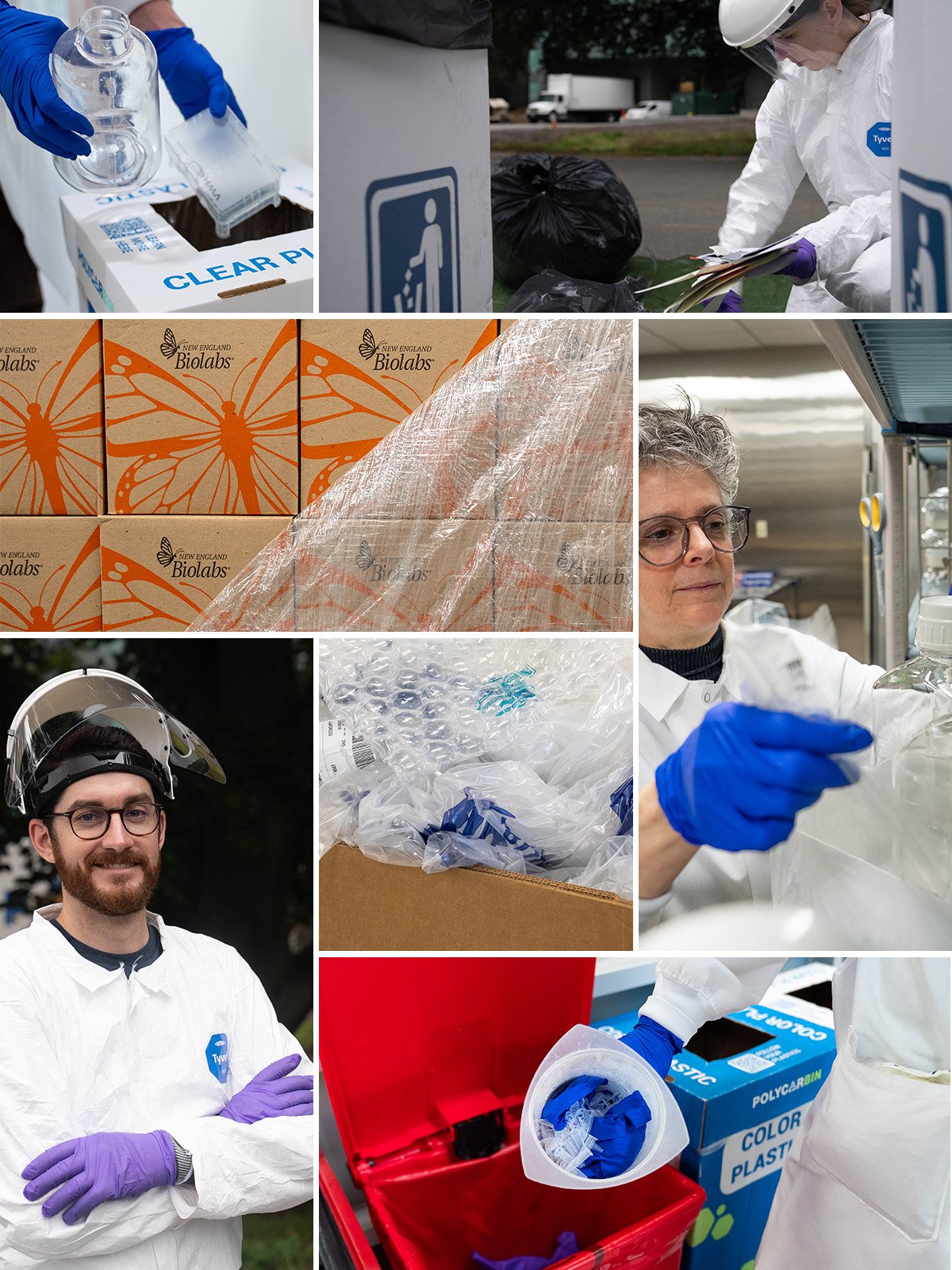
New England Biolabs scientists were concerned about flexible plastic film waste, assisted in data collection for a full-site waste audit, and are currently piloting a new plastic film recycling program.
Q6: So, essentially, biologists should rely on waste audit data and expect specialized lab recycling programs to require extra effort?
Lab or facility waste audits reveal the opportunities. Some programs may appear to create more work, but it’s also important to recognize that these spaces are already managing the material, we are just adjusting a process.
Q7: Do you see green alternative lab plastic materials succeeding?
We need it to! The efforts being made to reduce the production of virgin plastic are noble, and we are always looking for ways to integrate new solutions at NEB. At the same time, greener alternatives can create new questions, so we need to be thoughtful when considering new products. Haulers may be cautious about accepting new materials in their diversion programs. Molecular reagents or biological samples also interact differently with different materials, which can impact usability. Packaging must protect scientific materials in transit and in storage, and sometimes these materials just don’t perform as needed, which is particularly challenging in an industry that relies on packaging automation designed for precise plastic characteristics.
Regardless of the challenges, what I love about New England Biolabs is that even when one greener alternative doesn’t work, we’re determined to continue searching for other alternatives and run those through the testing and verification process. Failures don’t end the conversation. Our teams are always looking out for new products that might work, and it’s exciting to see new products being developed and come to market over time. It’s just a matter of finding the right fit.