Labconscious®

Connecting biologists to green labs and sustainability
  • Home
  • Blog
  • Green Lab Tips
  • Lab sustainability training game
  • Resources
    • Laboratory Recycling
    • Guidance on best practices
    • Green Chemistry
    • Supportive Data, Guides and Tools to Optimize Laboratory Energy Consumption
    • Grants and Funding
    • Laboratory equipment and supplies reuse
    • Play & Learn How to Minimize Laboratory Waste
  • Search our site
  • Green Lab Groups
  • Green Lab Supplies and Laboratory Equipment Guide
  • Home
  • Blog
  • Green Lab Tips
  • Lab sustainability training game
    • Laboratory Recycling
    • Guidance on best practices
    • Green Chemistry
    • Supportive Data, Guides and Tools to Optimize Laboratory Energy Consumption
    • Grants and Funding
    • Laboratory equipment and supplies reuse
    • Play & Learn How to Minimize Laboratory Waste
  • Search our site
  • Green Lab Groups
  • Green Lab Supplies and Laboratory Equipment Guide

Blog

A sustainability blog for biologists whose goal is to reduce laboratory waste, use green chemistry, and improve efficiency. Green labs thrive!

  • All
  • Biotechnology
  • Campus Sustainability
  • Cell Culture
  • Cold storage
  • Energy and Emissions
  • Ewaste
  • Fieldwork
  • Funding
  • Green Biotech
  • Green Chemistry
  • Green Lab Certifications
  • Green Lab Tips
  • Green Procurement
  • Green Science Buildings
  • Greening Champions
  • Greening Lab Materials
  • Lab Certification
  • Lab Safety
  • Lab Supplies
  • Lab Supply Chain
  • Laboratory Equipment
  • Microbiology
  • Model Organisms
  • Molecular Biology Waste
  • Natural Conservation
  • Nature Conservation
  • Pipette Tip Waste
  • Plastics
  • Programs and Logistics
  • Recycling
  • Reuse
  • Robotics
  • Scientific Communications
  • Sustainable Lab News
  • Sustainable Living
  • Synthetic Biology
  • Technology
  • Travel
  • Waste Audits
  • Water
New England Biolabs knows that recycling biohazard waste is safe, sustainable and smart.

New England Biolabs scientists use a biohazard waste recycling program that is safe, sustainable and smart.

Sustainable Lab Safety with Triumvirate Environmental

Nicole Kelesoglu October 5, 2017

The Red2Green recycling service reduces biohazard waste treatment loads and contributes to sustainability

Today's Labconscious interview is for laboratory researchers interested in an easy to use and eco-friendly red bin system. Our thanks to Ian Lanza who is a regional life science director for Triumvirate Environmental, a provider of turnkey environmental and hazardous waste management services to education, healthcare, industrial, and life sciences labs...including New England Biolabs!


1. Disposable lab consumables are often necessary to lab work.  Researchers want to be able to dispose of these materials in a safe and sustainable way.  How does waste minimization work, and what kinds of goals does Triumvirate Environmental help life science labs meet?

A true waste minimization effort must take a holistic approach beginning with the materials and waste generating process all of the way through final management of the waste.  My team and I work with researchers and institutions to understand the waste generating process with the individuals creating the waste.  The better we understand the process and the materials, the more successful we are in finding the most sustainable management method.  We will try to first eliminate a waste by altering the process or changing the material.  If we cannot not eliminate the waste, we will be work to classify and collect the waste in a manner that can be easily reused or recycled.  With this approach we have been able to reduce or eliminate waste streams, or divert waste streams from less sustainable treatment methods (landfill or incineration) to more sustainable treatment methods (reuse or recycling). 

The more progressive institutions have developed sustainability programs with teeth.  By this I mean, programs with real goals and targets.  Often, sustainability programs target waste management programs.  My team and I have partnered with some of the largest and most innovative life science companies in the world to help them hit their waste minimization and recycling goals by starting with the waste generating process, and ending with the final treatment and disposition of the material. 


2. What is Red2GReen? How is biomedical waste usually disposed of, and how does Red2Green improve on that? What lab items are eligible? 

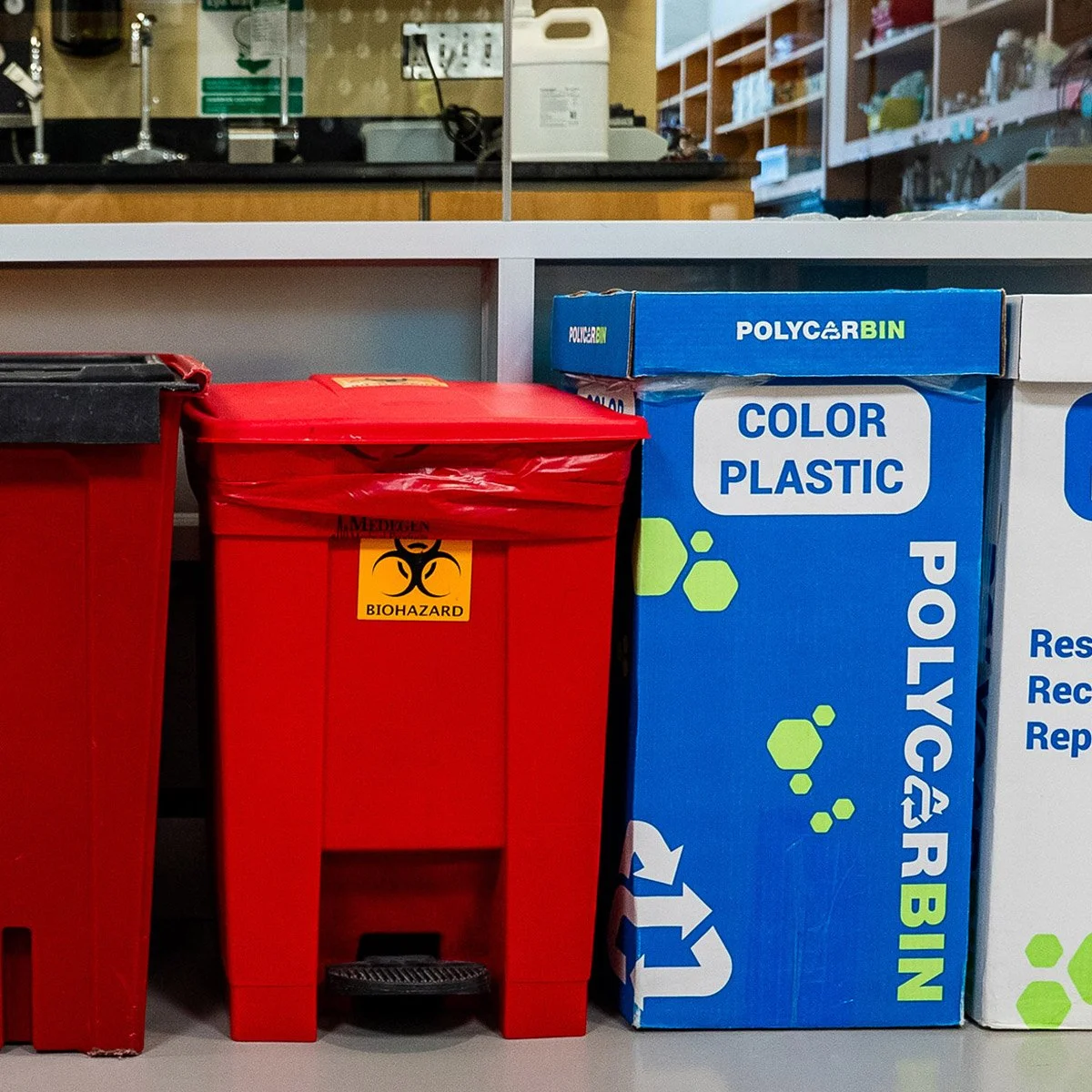
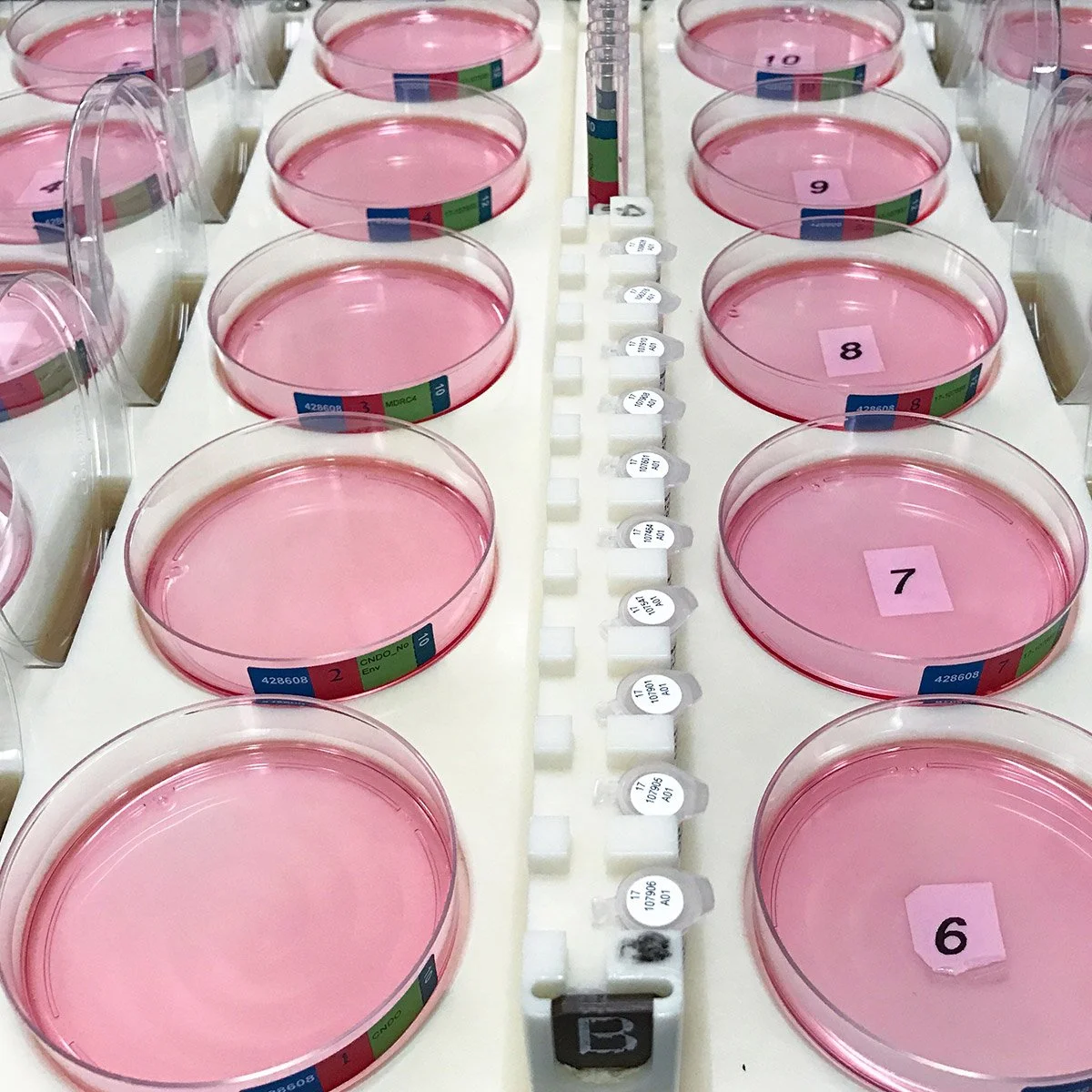
Triumvirate’s Red2Green program is the only program I know of that is recycling treated regulated medical waste.  All other existing treatment processes either result in treated material being landfilled or incinerated.  Both landfill and incineration pose significant environmental challenges, including green house gas pollution and water pollution.  Red2Green is a true recycling program where we are taking regulated medical waste from research and manufacturing facilities, treating the waste per CDC and state approved technologies, and then sending the treated bi-product to our recycled plastic manufacturing facility.  The treated material is used as an input in our recycling facility where we are making industrial grade plastic lumber.  Common waste streams being captured from labs include contaminated gloves, petri dishes, roller bottles, stereological pipettes, tissue culture flasks and other biologically contaminated wastes.

We also work with some labs and bio manufacturers to source specific lab plastic.  In some instances we are able to take lab plastics and send them directly to our plastic manufacturing site.  We have partnered with EMD Milliporeto take many of their single use products including water filters at this facility. 


3. Researchers want to support sustainability, without being distracted from their lab work.  How do your services make lab recycling "user-friendly"? 

My team and I work closely with researchers to understand the waste generating and collection process.  In addition to understanding the process and materials, we try to understand how waste collection could be easier or more convenient for them.  We try to make waste minimization and recycling easier than the current status quo.  We have been largely successful with this approach.  Some examples of more convenient solutions include better containers and containers placed closer to work stations.

Triumvirate also offers an onsite support service, where our staff routinely go to your site to manage the waste program.  One of the goals of the service is to transfer the burden of safe, compliant, and environmentally sustainably waste collection and management from scientists to our professional staff.  Our team handles a lot of the material handling, as well as serves as a compliance and sustainability resource for researchers and labs. 


4. Many life science labs want to adhere to the "Principles of Green Chemistry".   How does Triumvirate Environmental aim for lab waste processing that is energy efficient, enhances degradation, prevents waste and pollution?

We have a multi layered approach to developing more sustainable environmental programs in the labs.  First, we are constantly investing R&D resources into developing more sustainable and efficient engineered solutions.  The best example of this is the facility and process which supports our Red2Green program.  We challenged the RMW treatment status quo to develop a better and more sustainable treatment process never before tried.   We have many other programs or engineered solutions that result in safer or more sustainable results.  Another example is our VOClok system for collecting volatile solvent waste streams.  VOClok limits exposure to workers, and makes waste collection easier and safer.  We then couple our engineered solutions with a hands on approach in the lab.  We live in the labs at the intersection of scientific process and environmental and health programs.  We work hard to understand the nuances of scientific and organization processes.  This allows us to manufacture better results in the labs by altering process or material, or applying our engineered solutions in a manner that is easy for scientists. 


5. Does Triumvirate Environmental assist with reporting to demonstrate the benefits of waste minimization?

Absolutely.  Like any program, it is vital to articulate the impact our waste minimization and sustainability programs have on organizations.  I often work with organizations to understand what their data or reporting needs may be to ensure we are providing meaningful and relevant metrics.


6. Can you give an example of a "big win" by any of your life science lab clients?

A recent Red2Green success story came from one of our big pharma clients in the area.  They were treating their RMW onsite using an aging process that was causing many financial, logistical, and regulatory issues.  The systems required two daily operators, and had recently caused several environmental violations.   As they looked for a better way to manage the waste stream, we presented our Red2Green program.  Because our process was a completely different we had to work closely with manufacturers and researchersrevamp the waste program in the labs.  We worked closely with researchers to identify better waste containers and developed new work flow to ensure waste removal services linked up with their manufacturing runs.  By working closely with the onsite users of the service, our Red2Green program didn’t only result in a more sustainable management of the material, but a better experience for the researchers and manufacturing technicians who generate the waste.  YTD we have treated and recycled 210,000 pounds of waste, which were previously being sent to a landfill.

I partnered with New England Bio Labs several years ago to roll out our Red2Green program.  With our Red2Green program we were able to eliminate cardboard from the RMW waste steam, right size the waste shipments (reduced trucking fees) and diverted over 45,000 pounds of RMW from landfill to recycling. 

 
Our latest articles on sustainable life science
The Wyss Institute Delivers Materials Inspired by Biology and Adopted by Industry
July 28, 2026
Green Biotech, Synthetic Biology, Green Chemistry
The Wyss Institute Delivers Materials Inspired by Biology and Adopted by Industry
July 28, 2026
Green Biotech, Synthetic Biology, Green Chemistry

Engineering a new material type is impressive; anticipating long-term health and ecosystem impacts of an engineered material takes real foresight. Within the Harvard University system, the Wyss Institute develops improved, nature-inspired materials to solve real-world problems through concerted engineering and scientific R&D, culminating in commercialization.

Read more →
July 28, 2026
Green Biotech, Synthetic Biology, Green Chemistry
Greening Research Labs at Boston Children's Hospital
June 22, 2026
Greening Champions, Lab Safety, Programs and Logistics
Greening Research Labs at Boston Children's Hospital
June 22, 2026
Greening Champions, Lab Safety, Programs and Logistics

Since launching a grassroots sustainability initiative in 2020, the Boston Children’s Hospital (BCH) Green Labs program has expanded, helping to save the equivalent of the energy used by 89 homes each day—and reducing lab freezer failures by 68%. What’s behind all the improvements? A compelling “why.”

Read more →
June 22, 2026
Greening Champions, Lab Safety, Programs and Logistics
Vetting Waste Minimization in Life Science Labs
April 6, 2026
Campus Sustainability, Plastics
Vetting Waste Minimization in Life Science Labs
April 6, 2026
Campus Sustainability, Plastics

In this interview, NEB sustainability manager, Levi Rogers, shares how taking a closer look at everyday lab workflows can uncover practical, site-specific opportunities to reduce waste—without compromising safety, rigor or productivity. You may find that solutions already exist for your own bench work.  

Read more →
April 6, 2026
Campus Sustainability, Plastics
Sustainability in Scientific Labs: What Happens to Unused Materials?
March 5, 2026
Green Procurement, Lab Supplies, Laboratory Equipment
Sustainability in Scientific Labs: What Happens to Unused Materials?
March 5, 2026
Green Procurement, Lab Supplies, Laboratory Equipment

Scientific laboratories prioritize safety, accuracy, and oftentimes, regulatory compliance.  Meeting these essential priorities creates an unintended consequence: a large amount of unused, unopened laboratory material quietly becomes waste. This widespread issue calls for an easy-to-use system to put lab surplus back into research use, with significant cost savings. This enables laboratories to do more with less while reducing scientific waste. This is the mission of the Wasteless Bio platform.

Read more →
March 5, 2026
Green Procurement, Lab Supplies, Laboratory Equipment
Can Ensilication Break Biomolecules Free from the Cold Chain?
February 4, 2026
Cold storage, Technology, Green Chemistry, Green Biotech
Can Ensilication Break Biomolecules Free from the Cold Chain?
February 4, 2026
Cold storage, Technology, Green Chemistry, Green Biotech

Ensilication can flip the script on nature by making biomolecule stocks thermostable, including complex biologics that are not amenable to lyophilization. Eliminating cold storage and transport requirements would boost sustainability for biomedical cold chains, biobanking and labs. Recent advances have made it an exciting new option in the life sciences.

Read more →
February 4, 2026
Cold storage, Technology, Green Chemistry, Green Biotech
Lab Automation and Integrated Platforms
October 28, 2025
Laboratory Equipment, Robotics, Biotechnology
Lab Automation and Integrated Platforms
October 28, 2025
Laboratory Equipment, Robotics, Biotechnology

Get an insider’s look at how research and clinical diagnostics are expanded by integrating software, data and robotics, as well as the opportunities “to dial” in workflows for cost and carbon savings.

Read more →
October 28, 2025
Laboratory Equipment, Robotics, Biotechnology
Lab Automation with Avinash Gill, Ph.D., Genentech
October 28, 2025
Biotechnology, Robotics
Lab Automation with Avinash Gill, Ph.D., Genentech
October 28, 2025
Biotechnology, Robotics

Learn what scientist, Avinash Gill, Ph.D., hopes more people will talk about, as he shares the cutting-edge approaches his team takes to drive the discovery of new medicines, in the first of a three-part series of parallel interviews on strategic lab automation.

Read more →
October 28, 2025
Biotechnology, Robotics
Strategic Lab Automation: Unlocking Efficiency, Sustainability, and ROI Across the Research Lifecycle — A three-part series of Parallel Interviews
October 28, 2025
Biotechnology, Robotics, Laboratory Equipment
Strategic Lab Automation: Unlocking Efficiency, Sustainability, and ROI Across the Research Lifecycle — A three-part series of Parallel Interviews
October 28, 2025
Biotechnology, Robotics, Laboratory Equipment

Lab automation is one of the most effective accelerators in life science research and development. Learn how biologists are using AI and automation in our parallel interviews with a select group of experts, and then consider joining them at the Future Labs West Summit.

Read more →
October 28, 2025
Biotechnology, Robotics, Laboratory Equipment
Lab Automation with Ilja Kuesters, Ph.D. Generate:Biomedicines
October 27, 2025
Technology, Biotechnology
Lab Automation with Ilja Kuesters, Ph.D. Generate:Biomedicines
October 27, 2025
Technology, Biotechnology

Research that tightly integrates design, build, and test accelerates discovery. Learn about cutting-edge “agent augmented” labs that support scientists with planning, execution, error recovery, and review in this Q&A.

Read more →
October 27, 2025
Technology, Biotechnology
Recycling Lab Equipment Recovers Valuable Raw Materials
August 14, 2025
Laboratory Equipment
Recycling Lab Equipment Recovers Valuable Raw Materials
August 14, 2025
Laboratory Equipment

Electronics recycling is having a moment. Can you guess the undercurrent? Much of it is artificial intelligence/AI. Recycling your obsolete lab equipment has always been an act of good environmental stewardship. That’s even truer now that mining is ramping up globally to supply raw materials for AI infrastructure. The increased demand is a call to lean into e-waste recycling services as an eco-friendlier alternative.

Read more →
August 14, 2025
Laboratory Equipment
InRecycling, Lab Safety Tagslab recycling, lab safety, regulated medical waste, Triumvirate Environmental, green chemistry
  • Blog
  • Older
  • Newer

Get insights on specific green Lab goals

No results found

Join us!

Get monthly articles and green lab tips to your inbox.

Thank you for signing up for monthly articles and green lab tips!


Interact with the Labconscious community


Email us!

How do you make your biology lab more sustainable?


linkedin-unauthyoutube-unauthx-formerly-twitter-unauthbluesky-unauth
  • Terms of Use
  • Privacy Policy
  • About
  • Contact
  • Cookie Policy
 
New England Biolabs
 

240 County Road
Ipswich, MA 01938-2723

Labconscious® is a registered trademark of New England Biolabs, Inc.

© Copyright 2026 New England Biolabs. All Rights Reserved.

Labconscious®

Connecting biologists to green labs and sustainability

Labconscious is an open resource for biologists to support sustainability and green laboratory work to reduce the environmental footprint of bench science.

New England Biolabs | 240 County Road, Ipswich, United States

linkedin-unauthyoutube-unauthx-formerly-twitter-unauthbluesky-unauth