
In my last post I shared some easy tips and resources to help you start a waste management program at your business or institution. One of those tips was to not reinvent the wheel, or, to look for programs already in place to base your own program off of. In this series of articles we are going to take an inside look at a Cell Signaling Technology’s waste management program. We will start by looking at their waste breakdown and then focus on each individual steam; what projects worked and which ones did not. The hope is that you can take what we have learned with our waste management program and apply it to yours.
Cell Signaling Technology Waste Management
When talking about CST’s waste footprint we generally break it down into four categories from which our waste is falling into; Recycling, Compost, Hazardous/ Chemical Waste and Trash. Recycling consistently makes up the majority of the waste, constituting on average 44% percent of our total footprint, Compost is the next largest piece of the pie comprising 26%, then Trash at 24% and Haz/Chem waste at 6%. While the waste management program has been in place since the company’s start, we were not recording metrics on it until 2011. For the past three years we have been benchmarking ourselves against the previous year. Below you can see how we did in 2013.

The first thing you notice is that the percentage of our total waste footprint coming from recycling and compost is less than our average from the previous two years. I attribute this to the company’s expansion to a new facility, but while we may be able to place the blame on expansion, we also had to figure out how to reduce the percentage our waste going to the landfill.
Full Staff Awareness
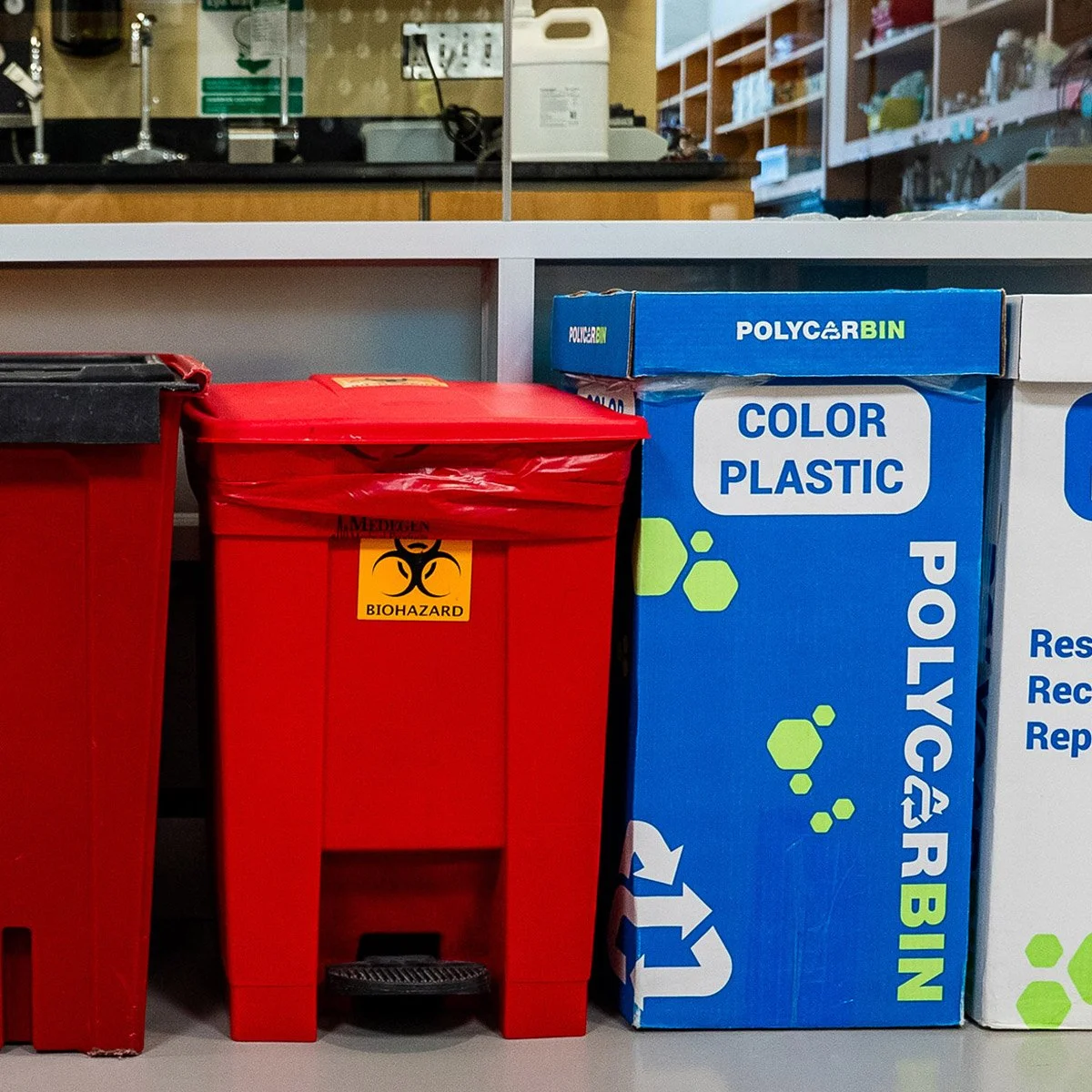
The first step we took to reducing our trash stream was to spread awareness about the issue to our employees. As I mentioned in my last post, awareness is a key piece of any waste management plan and CST is no different. We sent out emails, created signs, held meetings, and even color-coded our different waste receptacles (which helped a lot by the way), but the biggest breakthrough we had was simply buying clear trash bags. With this little improvement we were able to walk out to the dumpsters and see what was being thrown away; and by just seeing what our trash was made up of we were able to start focusing on ways to reduce those items. Some of those items, by the way, were paper towels, gloves and printer paper!

It was really disheartening to see printer paper in our trash stream. The company has been recycling since its inception in 1991, and if our employees were not putting paper in the blue recycling bins, then we had a lot more work to do than we had thought. By investigating this issue, we actually found out that the fault was not the employees’ alone, but a mix-up with our janitorial staff. A quick chat with the night janitorial staff sorted the problem out. With the printer paper issue taken care of, we went about trying to find ways to reduce our paper towel waste. Paper towels are used in the labs, cafeteria and bathrooms; they are one of those things that you use once, throw away and never think about again. When they are wet, the towels are heavy, and when dry they take up a lot of room in the waste bins which can lead to higher costs. Why do you even need them, anyway? In the labs and cafeteria it was obvious: to clean up spills. But in the bathrooms, they seemed unnecessary. With that we decided to phase out paper towels in the bathrooms and replace them with a cleaner energy efficient hand dryer. The cost to replace all the paper towel dispensers with hand dryers was too much up front, so we took a phased approach replacing in 2-5 bathrooms a year. As for those bathrooms where we hadn’t replaced the paper towels, we set up a program to compost them. The last item in the trash I mentioned was lab gloves, see my post CASE STUDY: RECYCLING NITRILE GLOVES VS SINGLE-USE LATEX to see how we solved that problem. With these three items alone we estimated that we were able to divert more than 3 tons of waste out of the “general trash” stream a year.
For most homes and businesses your trash ends up in a landfill. While landfills are sealed and monitored, many end up leaching out toxins hazardous to the local environment. New technology, however, is leading to lower leakage rates and also making use of landfill byproducts such as methane. Not all trash ends up in landfills; some haulers have waste to energy programs where your trash is burned to create energy. These plants are have advanced filtration systems and are heralded by the EPA as a less carbon intensive way to create energy. CST’s trash hauler has one of these programs and now our trash is being used to power 50,000 homes in Massachusetts.
In my next article we are going to look at the recycling portion of our waste stream.







Engineering a new material type is impressive; anticipating long-term health and ecosystem impacts of an engineered material takes real foresight. Within the Harvard University system, the Wyss Institute develops improved, nature-inspired materials to solve real-world problems through concerted engineering and scientific R&D, culminating in commercialization.